Sauce
Pizza Sauce Calculator: Grams per Pizza
Enter how many pizzas, how wide they are and how saucy you like them. You get the sauce in grams, tablespoons and cups, and how much of a can you are about to open.

Photo: Shisma, CC BY 4.0
How much sauce goes on a pizza
Sauce is the one part of a pizza that people measure by eye, and it is the part most often overdone. Too much and the base never sets: the sauce steams the dough from above, the centre stays pale and soft, and the rim collapses when you cut it.
The amount scales with area, not with how big the pizza looks. A 16-inch pizza has 78% more surface than a 12-inch one, not 33% more — double the diameter and you quadruple the sauce. That is why the numbers below jump the way they do.
| Pizza size | Standard | Light | Heavy (NY style) |
|---|---|---|---|
| 8 inch | 40 g | 28 g | 55 g |
| 10 inch | 63 g | 43 g | 86 g |
| 12 inch | 90 g | 62 g | 124 g |
| 14 inch | 123 g | 85 g | 169 g |
| 16 inch | 161 g | 111 g | 221 g |
| 18 inch | 204 g | 140 g | 280 g |
A 12-inch at 90 g is about 5 heaped tablespoons, or a third of a cup. If you have been using half a cup on a 12-inch, you have been putting 50% too much sauce on it.
What the box means by light, standard and heavy
The calculator multiplies the area of the pizza by a density factor:
- Light, 0.55 g per square inch. Just enough to cover, for a Neapolitan where the sauce is the main event and the cheese is sparse. 62 g on a 12-inch.
- Standard, 0.8 g per square inch. A home pizza with mozzarella and a couple of toppings. This is the default.
- Heavy, 1.1 g per square inch. New York style, where the sauce layer is visibly thick at the edge of the slice.
- Very heavy, 1.4 g per square inch. Deep dish and pan pizza, where the sauce sits on top of the cheese or forms its own layer.
From grams to cups and cans
One level tablespoon of tomato sauce is about 17 g, and there are 16 tablespoons in a cup. So:
| Sauce | Tablespoons | Cups |
|---|---|---|
| 60 g | 3.5 | 0.22 |
| 90 g | 5.3 | 0.33 |
| 125 g | 7.4 | 0.46 |
| 160 g | 9.4 | 0.59 |
| 200 g | 11.8 | 0.74 |
A standard 400 g (14 oz) can of tomatoes holds enough sauce for about four 12-inch pizzas at the standard dose. If you are making two, you will open a can and use half of it, and the calculator tells you the fraction so you can decide whether to scale the batch up instead.
Seasoning per 100 g of sauce
If you are making sauce rather than opening a jar, these ratios hold at any batch size:
- Salt: 1 g per 100 g of sauce, about 1%. Tomatoes are already salty enough that you rarely need more.
- Olive oil: 3 g to 5 g per 100 g, stirred in cold. It rounds off the acidity.
- Sugar: 0 g to 2 g per 100 g, only if the tomatoes taste sharp. Add after tasting.
- Oregano and garlic: to taste. Oregano loses its punch in the oven, so put half in raw and half on the finished pizza.
Do not cook the sauce down for a home oven pizza. Loose sauce cooks out in a 450 °C wood oven; in a 260 °C home oven it just makes the base soggy. If the sauce is too wet, drain the tomatoes for ten minutes instead of simmering them.
Pan and deep dish are different
For a pan pizza the sauce often goes on top of the cheese, drizzled in stripes, and the layer under the cheese is thin: 40% to 50% of the standard figure. Use the light density and ignore the pan depth. Deep dish is the exception. There the sauce is a visible layer on top, and 1.4 g per square inch is the low end of what Chicago style actually uses.
Leftover sauce
Sauce keeps 5 days in a sealed jar in the fridge, and freezes well in 90 g portions. A silicone ice cube tray with large cells gives you roughly one 12-inch pizza's worth per cell, which turns half a can left over into four single-pizza portions.
Questions
Is 90 g of sauce a lot for a 12-inch pizza?
It is a thin, even coat, thin enough that you can see the dough through it in places. Most people who think they want more sauce actually want more cheese or a hotter oven.
Should I use passata, crushed tomatoes or paste?
Passata for a smooth base, crushed for texture, and paste only to thicken a sauce that is too wet: one tablespoon per 400 g. Paste on its own is too concentrated for a pizza base.
Does the calculator work for a rectangular tray?
Not directly. Measure the tray in square inches (length times width) and pick the round size with the closest area. A 9 by 13 inch tray is 117 square inches, so use the 12-inch row.
Can I put the sauce on and wait?
Up to an hour on a dressed pizza, no longer. The salt in the sauce pulls water out of the dough through the sauce layer and you get a gummy base. Sauce the base right before it goes in.
How much sauce for a calzone?
About 60% of the pizza figure for the same dough weight, and keep a spoonful back to serve on the side.
Related
Once the sauce is sorted, get the dough from the pizza dough calculator and the water ratio from the hydration calculator. If your recipe gives tomatoes in cups rather than grams, the grams to cups converter covers the conversion.
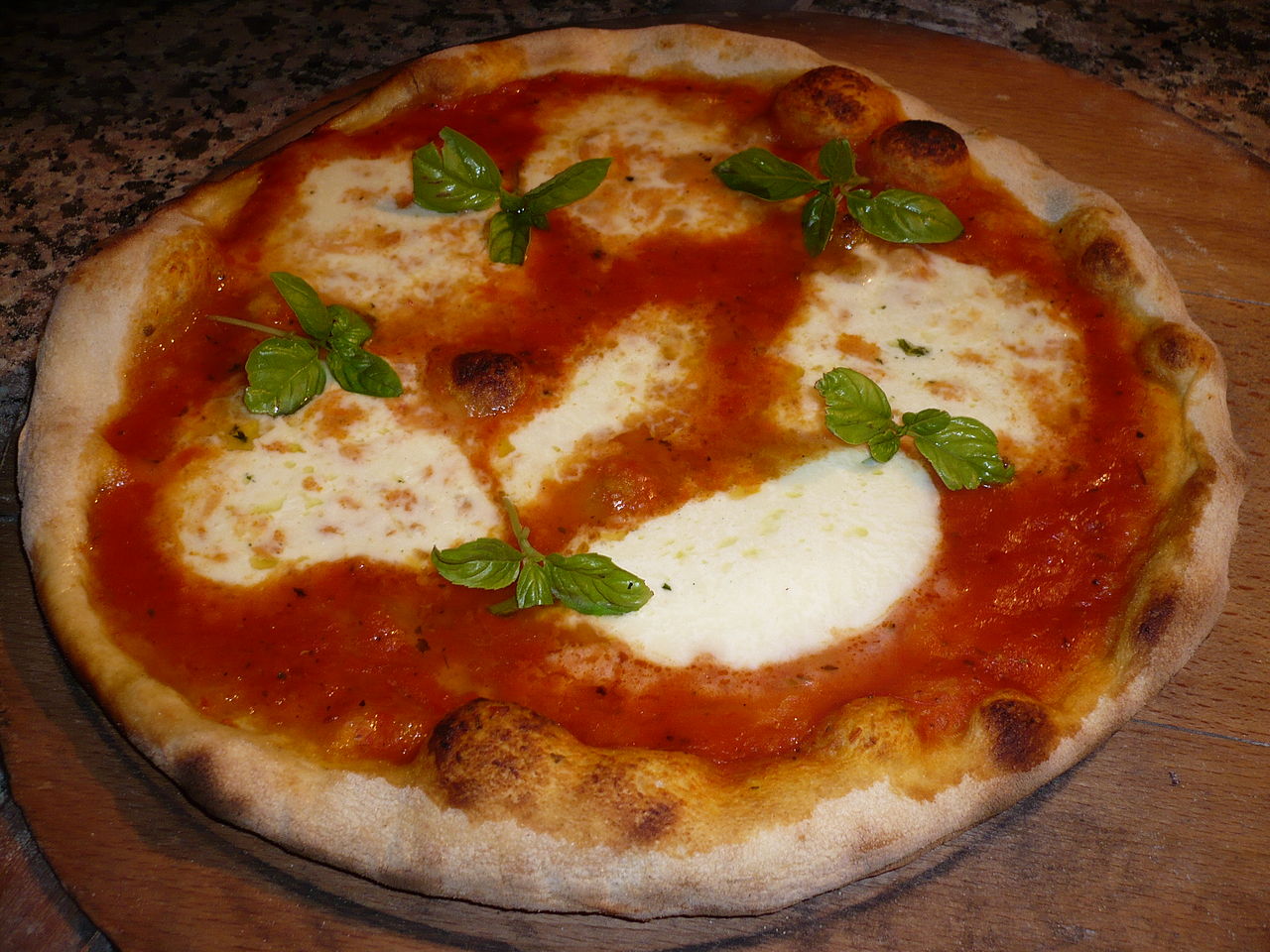
Photo: Mario56, CC BY-SA 3.0